

We need economic principles to understand the impact of Trump’s policies on growth.
Call it the Big Beautiful Bill. Or view it as the Big Bad Betrayal. Trade Liberation Day or Disaster. Whatever your political leanings, make sure you remember basic economic principles when formulating your opinion about them. A principle is a foundational truth that drives economic behavior, e.g., people choose a product based on its perceived functional and emotional value.
In this blog, I’ll review five fundamental economic principles that are central to understanding the impact of the BBB and tariff policy on our economic growth.
Opportunity Cost
When making purchasing decisions, we assess the value of the product or service. We also compare this value to what else the money could have been spent on, i.e., its opportunity cost. One opportunity cost of a purchase is lower savings. Another is forgoing a different purchase. If the perceived opportunity cost is higher than the perceived value, we don’t purchase.
One place where opportunity cost arises is the effect of government policy on our national debt. The BBB’s tax cuts will create a record increase in our deficit and, therefore, debt level. Interest payments on the debt are already close to 10% of federal government spending. Payments will grow significantly under the BBB; so, even if tax rates and economic activity stay the same in the future, there will be less money for other spending because a higher share of our tax revenue will go to paying the interest on our national debt.
Sidebar: Will the tax cut pay for itself?
Trump and the GOP’s argument for lowering taxes despite the deficit and debt is based on Supply Side Economics, which is a theory, not a principle. It claims that lower taxes will generate more economic growth, resulting in tax revenue greater than the amount lost from the cut – i.e., any cut pays for itself. This belief was true when our highest tax rates were well above 70%. But the theory has been debunked decisively in our era of low taxes. Realistically, we cannot expect the BBB’s tax cut to pay for itself.
Another opportunity cost of government spending and taxing is lower personal income (net of taxes). We rely on our Congress to decide what government spending is worth the reduced individual income.
Public Goods
One of the largest categories of government spending is public goods. These are goods and services which everyone has access to and in which any one person’s consumption does not reduce another’s. Our national defense system, infrastructure, disaster preparedness and support, cleaner air, public health, and K-12 education system are a few examples.
The BBB dramatically cuts our social safety net, science investments, food assistance, and health insurance. Is removing immigrants (with no criminal records) worth the opportunity cost of less spending on other goods? Are the areas being cut less valuable to society than giving tax breaks that flow disproportionately to the wealthy? The research expenditures at the National Science Foundation, National Institutes of Health, and our public and private universities have led to new industries and cures for diseases. Medicaid keeps people healthy so they can work and reduces longer-term healthcare costs. It also prevents cost-shifting onto private employers who insure their workers. Does Trump’s trade-off make sense?
Supply and Demand
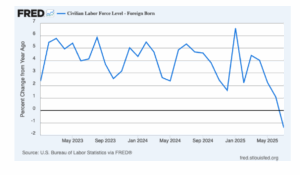
Our labor supply is falling under Trump’s deportation policies.
Supply and demand curves illustrate how the supply or demand for a good or service changes in response to price changes. In general, higher prices bring about more supply and less demand. The BBB increases government spending by about $200B on securing the border and deporting illegal immigrants from our nation. Trump’s deportation plans will lower the supply of labor and raise wages overall. Higher net wages appear like a good thing, but the effect of dramatic deportations will be not unlike the supply shocks we had with OPEC in the 1970s and COVID more recently. We’re already seeing higher inflation at a time when we are trying to reduce it. So even if your wage increases, the dollar won’t go as far. And a lower labor supply lowers economic growth.
Competitive Advantage
We understand the concept of competitive advantage from business – it is what a firm can uniquely do well that is
- Hard to copy
- Delivers benefits to a customer group, and
- Advantage in moving into new markets.
Competitive advantage earns higher margins, all else equal. Nations also have competitive advantages – things they do uniquely well. One of the U.S.’s most substantial competitive advantages has historically been innovation, which has attracted great minds from overseas to our country. And it’s generated exceptional economic wealth. Trump’s cuts of 40% to the NIH and 56% to the National Science Foundation will decimate this advantage and our economic growth.
Trump’s tariffs will also undermine our economic growth. Other nations can make things more cheaply than we can. Taxing these goods through tariffs is, in essence, a sales tax on what Americans buy. And there’s a bad edge to tariffs. 50% of 2024 imported goods were industrial supplies or capital goods used by US businesses to make other goods. Raising the prices of these goods will make our exporting companies less competitive. The administration claims that Trump’s trade deals will remove barriers to our exports. But it is unclear how these will be enforced.
Marginal Propensity to Spend
No matter the size of our income, we all have required purchases (on rent or mortgage, food, etc.). We have a choice of what to do with other income: spend it or save it. The marginal propensity to spend is the percent of an extra dollar a person will spend (versus save).
A significant majority of the BBB’s tax cuts are to the wealthy, who are unlikely to spend the money, as their marginal propensity to spend is low. Instead, they will save most of it, which will help partially mitigate the increase in interest rates our growing debt will create. That is good.
But to drive economic growth in our consumption-driven economy, you need money flowing to those with the highest marginal propensity to spend. The BBB and tariffs (which are a regressive tax) reduce the net income of our poorest residents, hurting economic growth. Indeed, this is why tax cuts geared mainly to the wealthy do not pay for themselves.
Budget Bills as both Morality and Economics
The budget is a moral document as well as an economic plan. I’ll leave you to decide on its morality. As an economist, I’d say it’s a loser as an economic growth plan, as are his tariffs.